
How to Choose a Domain Name for a Local or Global Business
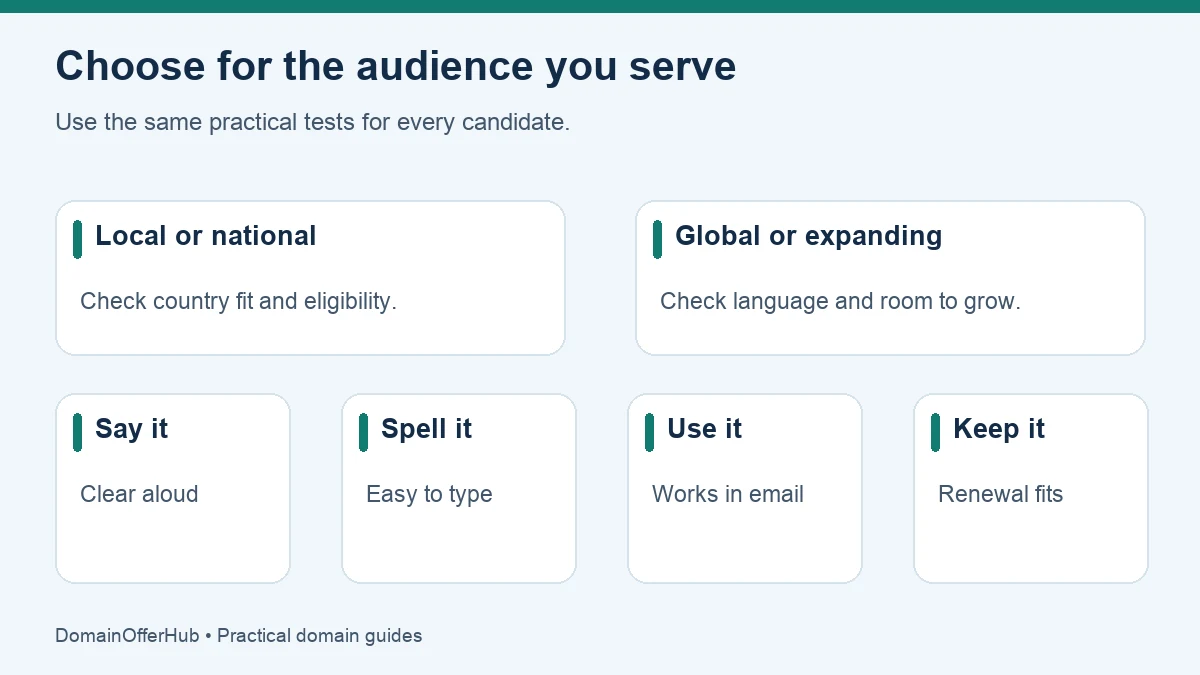
Choose a domain name that your audience can remember, spell and trust, with an extension that fits your market and a renewal price you can sustain. Start with the business and customer journey; check availability after you have a shortlist.
The best candidate on paper is not always the best one to say over the phone, print on packaging or use in an email address. This practical decision process helps you test those situations before paying.
Start with your audience: local, national or global?
Write a one-sentence description: “We help [audience] with [service] in [market].” Then decide whether your domain should reinforce a location or leave room for expansion.
| Situation | Useful direction | What to verify |
|---|---|---|
| One-country business | Compare a relevant country-code ending with a familiar generic option. | Residency, local presence or other registry requirements; customer expectations. |
| International product | Favor a brand and ending that remain clear across target markets. | Pronunciation, language meanings and the cost of the exact name. |
| Specialist community | A descriptive ending may explain the subject. | Eligibility, credibility with that audience and renewal pricing. |
| Business likely to expand | Avoid an unnecessary city or narrow product restriction in the core brand. | Whether today’s specific name would need replacing later. |
A country ending can be helpful for a focused market, but it is not a promise of local search rankings. Some country-code endings are widely used internationally. Check the individual extension guide rather than treating every two-letter ending the same way.
Make five candidates, then apply practical tests
The spoken test
Say the name once without spelling it. Can someone write the intended address? Numbers can be heard as words, and unusual spellings can require repeated explanation. A hyphen is not automatically unacceptable, but it adds something a customer must remember to say or type.
The email test
Read “hello at your-name dot extension” aloud. Inspect the complete address in lower case. Look for ambiguous letter combinations and words that become awkward when joined. Your domain will often appear outside the website itself.
The small-screen test
Put each candidate in a simple text mock-up at phone size. Does it remain legible in a profile link or invoice? Do not rely on a logo to explain missing letters: links and email addresses generally appear as plain text.
The expansion test
Imagine adding a new service or selling outside the initial city. A highly specific name can be useful, but choose it intentionally. Buying a second domain later does not remove the work of redirecting links and updating customer-facing material.
Use a scorecard that reflects your business
Rate each candidate against the same criteria: easy to say, easy to spell, meaningful to the audience, room to grow, appropriate extension and affordable renewal. You can use simple pass/fail checks or your own scores. These are your decision inputs, not an objective SEO score.
For example, a local bakery may prefer a clear town-and-brand combination to an abstract invented word. An international software tool may make the opposite choice. Keep a note of why the finalist works so a cheap alternative does not distract you at checkout.
Our name suggestion tool can produce starting points based on your business, local or global audience and country. Treat its output as ideas to check, not reserved names or legal approval.
Check availability and rights separately
A registrar search can tell you whether a particular registration is currently offered. It cannot establish that you have the right to use a similar business or product name. Search existing businesses and the appropriate official trademark databases for your intended markets. If the name is central to a significant launch and the result is uncertain, obtain suitable professional advice before investing in branding.
Also check whether an unavailable domain is an active business, a parked name or an aftermarket listing. Do not assume “no website” means “unregistered.” A different brand can be a better decision than a near-copy of a competitor’s address.
Do not choose a name solely for an SEO promise
Google’s SEO Starter Guide recommends choosing what works for the business; keywords in a domain alone have little ranking effect. Its ranking-systems guide also describes safeguards against excessive credit for exact-match domain names.
A readable, useful name can support marketing, but it does not replace a useful site. Avoid paying a premium simply because someone promises that an exact phrase or fashionable ending will rank automatically.
Confirm the cost of the finalist
Check registration and renewal for the exact name. A standard extension price does not guarantee the same amount for a registry-premium name. Compare native-currency quotes, tax basis and required terms. Use the ownership cost calculator if you expect to keep the domain for years.
Then register the finalist in an account your business controls. Save optional defensive registrations for real confusion risks and a clear budget rather than buying a large collection out of anxiety.
Quick questions
Must every business use .com?
No single extension fits every audience. Compare familiarity, relevant alternatives, eligibility and cost. A clear available name can be more practical than an awkward variation chosen only for one ending.
Should I include my city?
It can clarify a local service, but consider whether it will become restrictive. Test it against your actual expansion plans.
What if my first choice is taken?
Try a meaningful modifier, an appropriate alternative extension or a different brand. Confirm the result is distinct and affordable before committing to design work.
Editorial review: 25 October 2026. Sources are linked beside the relevant explanations. Provider processes and pricing can change; verify current requirements before acting.