
How Long Does a Domain Transfer Take? Timeline, Locks and Delays
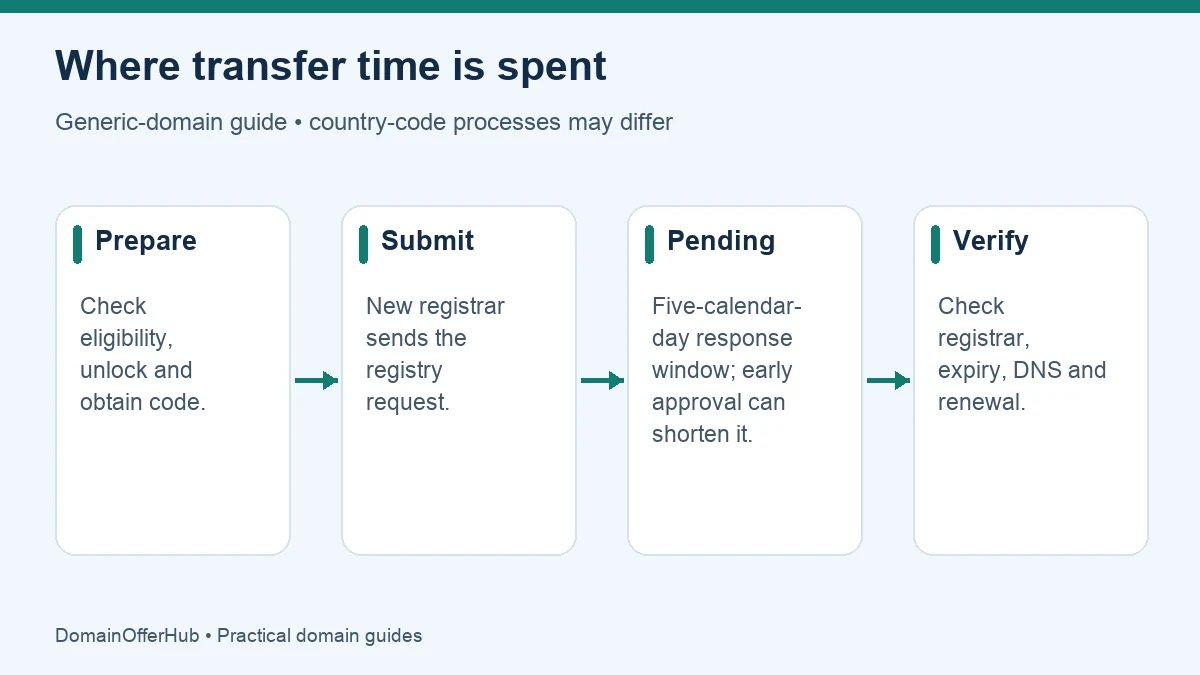
An eligible generic-domain transfer can complete sooner if approved promptly, while the registry transfer stage normally has a five-calendar-day pending window. Preparation, registrar processing, missing approvals and transfer locks can add time. Country-code extensions can use different processes.
There is no reliable countdown until the gaining registrar has actually submitted the transfer to the registry. “I ordered a transfer today” and “the domain entered pending transfer today” are different events.
Know which kind of move you are making
| Action | What changes | Why the timeline differs |
|---|---|---|
| Inter-registrar transfer | The company sponsoring the registration. | Eligibility, authorization and registry processing apply. |
| Account-to-account move | The account holding the name at the same company. | The provider’s internal process applies; this is not automatically a registry transfer. |
| Registrant change | The registered holder’s details. | Confirmation steps and a possible transfer lock can apply. |
| Hosting or DNS move | Website service or DNS routing. | Service setup and DNS caching matter, without necessarily changing registrar. |
For example, moving a domain between two accounts at GoDaddy is different from moving it from GoDaddy to another registrar. Start with the exact operation in the provider’s current help instructions.
A realistic transfer timeline
Preparation: before the registry clock starts
Confirm eligibility, check access to the registered contact email, obtain the authorization code, remove an eligible transfer lock and start the request at the new registrar. The code may be available immediately in the account, but that is not guaranteed. ICANN’s policy specifies obligations for providing AuthInfo and unlocking when self-service is unavailable.
Submission and approval
The new registrar processes your request and submits it to the registry. Follow legitimate confirmation instructions and check the status in both registrar accounts. Some providers let you approve release early. Avoid making contact-detail changes mid-process without understanding their effect.
Pending transfer at the registry
The current ICANN Transfer Policy provides a five-calendar-day response window for the losing registrar. An explicit approval can shorten that stage; no response results in default approval under the policy. That window is not a promise that every transfer order completes within five days of payment.
Completion and checks
Confirm the new registrar appears in the account and public registration data. Verify the expiration date, renewal settings, lock, contact details and DNS behavior. Keep the old account accessible until the move and any related service changes are confirmed.
Why a domain may be locked or delayed
ICANN’s registrant transfer FAQ describes restrictions including a domain within 60 days of initial registration or a previous transfer, and a 60-day change-of-registrant lock. Some registrars offer an advance opt-out for the latter; do not assume you can remove it after changing details.
- Incorrect authorization code: request a current code and paste it accurately.
- Transfer-prohibited status: identify whether it is a removable account lock, a timing restriction or another restriction.
- Missing confirmation: check the verified account and contact inbox, including filtered mail.
- Payment or order not completed: a saved basket is not a submitted transfer.
- Dispute or registry restriction: ask the registrars for the specific reason; another payment will not remove the restriction.
If the status is unclear, ask the new registrar: “Has the request been submitted to the registry, and on what date?” Ask the current registrar for any rejection reason. This is more useful than restarting the order repeatedly.
Will the website or email stop working?
A registrar change does not itself require a nameserver change. However, DNS or forwarding bundled with the old registrar may not continue after transfer. Ask whether the existing service will remain active, and arrange replacement DNS before you depend on it.
Back up all relevant records and inspect DNSSEC arrangements before moving DNS. Keep the website and email services paid and active. Avoid scheduling a registrar transfer, nameserver migration and mailbox cutover together if you can separate them.
Plan before expiration and compare the complete cost
Start with a buffer rather than relying on a transfer completing just before expiration. Review the extension’s rules and each registrar’s terms. A transfer often includes additional registration time for generic domains, but exceptions and timing details exist; verify the resulting expiry date instead of assuming every extension adds a year.
Use the registrar directory to investigate destination providers and the extension guides for context. Registration offers are not automatically transfer offers, so inspect the merchant’s transfer basket and renewal rate separately.
Transfer questions
Are the five days business days?
The policy’s pending-transfer response period is expressed in calendar days. Other account or support steps can have their own processing times.
Can support guarantee an instant transfer?
No universal instant process exists. Early release depends on the provider, eligibility and current status. Ask about the specific pending stage.
Do country-code domains follow the same rules?
Not necessarily. The relevant registry may use a different authorization method, registrar-change process or timetable. Check that extension’s official requirements before applying generic-domain advice.
Editorial review: 25 October 2026. Sources are linked beside the relevant explanations. Provider processes and pricing can change; verify current requirements before acting.